One agent is often enough
By Andrew D. Anderson
On November 18, Vercel released Board, an open-source message board for agents. Threads hold the discussion and can turn into tasks with dependencies and claims. Agents pick up work, post results, and move on.
It is a clean idea, and it made me ask an uncomfortable question about hob.
hob already lets agents message each other directly. My own daily workflow is an orchestrator agent with a couple of implementers that report back to it. Should hob have a board too? Would that make my workflow faster or cheaper?
So we ran an experiment. The board question turned out to be the less interesting result.
One task, seven ways
Every run built the same small expense ledger: a Python CLI backed by SQLite, with all-or-nothing CSV import, duplicate handling, summaries, and export.
After the first version was done, every run got the same steering. A revision came in to support refunds and pending transactions without breaking old databases. A duplicate request and a withdrawn request were mixed in. At the end came a simulated release that had to wait for both a current CI result and an approval.
All seven runs used the same model at the same effort (GPT-6 SOL at medium) and were graded against the same 54 hidden product checks, written by a separate agent that never saw any of the implementations.
Only the shape of the team changed:
- An orchestrator with two long-lived implementers, using direct messages. This is how I usually work.
- The same team, coordinating through a board.
- An orchestrator with a fresh implementer for each task, using the board.
- No orchestrator. Fresh workers claim tasks from the board.
- No orchestrator. Long-lived owners handle their board threads.
- Fresh triage agents route each event to fresh board workers.
- One agent. No board, no helpers. One conversation, the way a person works with a single agent.
The seventh run was an afterthought. I asked for it after the first six had finished.
The results
All seven passed all 54 checks. All seven released correctly, once.
| Run | Shape | Agent sessions | Time | Cost |
|---|---|---|---|---|
| 1 | Orchestrator + long-lived implementers, direct messages | 3 | 8:17 | $1.35 |
| 2 | Orchestrator + long-lived implementers, board | 3 | 7:55 | $1.33 |
| 3 | Orchestrator + fresh implementers, board | 7 | 11:03 | $1.97 |
| 4 | Fresh board workers, no orchestrator | 9 | 11:40 | $1.69 |
| 5 | Long-lived board owners, no orchestrator | 3 | 8:06 | $1.29 |
| 6 | Fresh triage + fresh board workers | 12 | 13:34 | $1.76 |
| 7 | One agent | 1 | 5:33 | $0.43 |
The single agent finished in 5 minutes 33 seconds for 43 cents.
Compared to my usual workflow (run 1), it was 33% faster and 68% cheaper. Against the cheapest team, it cost a third as much. Against the most expensive, less than a quarter. It made 31 model calls. The teams made between 104 and 166.
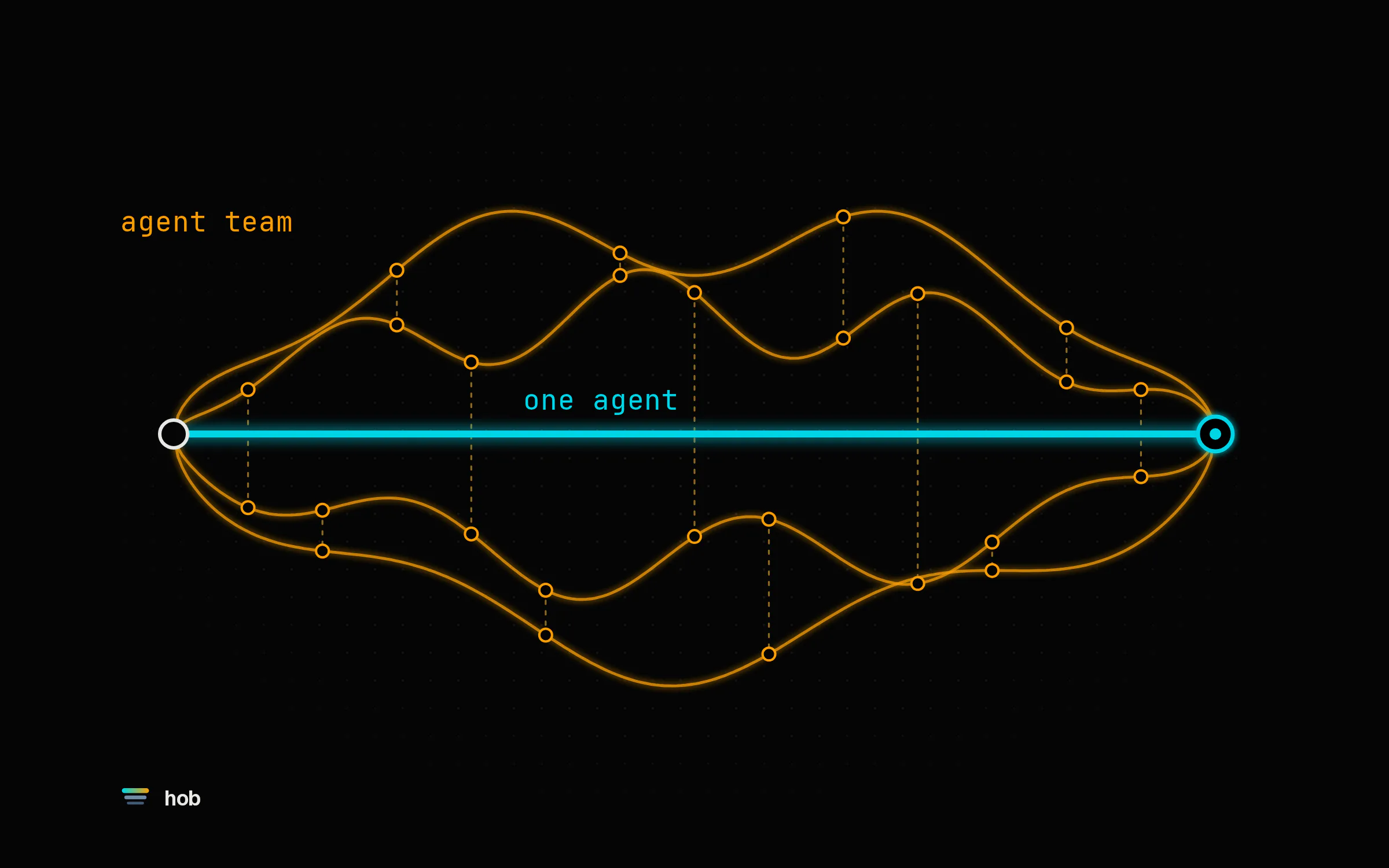
Functionally, the output was the same. More agents did not produce a better ledger. They produced the same ledger, later, for three to four and a half times the cost.
Where the money went
It went to coordination.
Every agent on a team has to be told what the work is. It has to read the shared plan, report its status, and wait on someone else's status. An orchestrator reads all of those reports and writes all of those assignments. None of that builds the ledger.
Runs with fresh workers paid a second tax. Each new worker starts cold and has to rebuild its picture of the task from threads and files before it writes a line. Run 5 kept its agents alive and finished 31% faster and 24% cheaper than run 4, which did the same job with fresh workers. The two runs that leaned hardest on fresh workers were also the only team runs that mislabeled events.
The single agent paid neither tax. It never had to explain anything to anyone. The whole task lived in one context from the first message to the release.
And the task fit. We checked afterward: across all 38 agent sessions, not one had to compact its context. The single agent's largest request was around 45,000 tokens, under 18% of the model's context window. It had room for this project several times over.
The obvious pushback is that the task was small. A ledger that fits in a fifth of a context window is not a sprawling codebase.
That is fair, and it is most of the point. A lot of the work people actually do with agents is this size: a narrow app, one feature, a fix with a revision after review. Low to medium complexity, well inside one context. The machinery in the other six runs is built for a different class of problem, and most days that is not the problem in front of you.
If your work genuinely is long and sprawling, this result is not aimed at you. It is aimed at reaching for an agent team and a task board by default.
What this does not show
This was one trial per shape. Agent runs vary, so small gaps here mean nothing. The six team runs went in two batches of three, and the single agent ran alone afterward. Costs are estimates at published API rates, not billed charges. The board runs also used a local stand-in modeled on Board, not Vercel's Board itself. We did not want a third party sitting in the middle of our agents, and we wanted to test the idea rather than one specific implementation.
The single agent was not spotless either. It logged one event with the wrong label, recording a stale CI result it should have ignored, though it still held the release until the current CI result and approval arrived.
The bigger limit is the task size. This was a regular-sized feature that fit in one context with room to spare. Nothing here tells us what happens on a long project where a single agent compacts several times and starts forgetting its own decisions. That is where a team, or a board, might actually make sense. That is the experiment we will run next.
Start with one
Most day-to-day work is a regular-sized feature.
It is easy to mistake more agents for more progress. A dozen sessions and a task board look like a real engineering org. For work this size, they are just overhead: you pay for the agents to talk to each other, and you get the same result later.
We still use teams of agents. hob supports that, and we build hob with them every day. A second agent earns its cost when the work outgrows one context, when the pieces are genuinely independent, or when you want a reviewer that did not write the code.
But the default should be one agent, in one conversation, for one task. Run sets of those in parallel across separate tasks instead of forcing a team into false collaboration on one. Bring in a second agent on the same task when the work actually asks for it, not before.
The board you already have
That brings me back to the question I started with: does hob need a board?
Adding a board to my existing workflow (run 2 against run 1) changed 22 seconds and 2 cents. Well within the noise of a single trial.
In hindsight, that makes sense. Look at what a board gives a group of agents: a shared record, a place for tasks and their status, a way to hand work off, and a history that outlives any single session.
Now look at the workspace in run 1. The agents are long-lived, so there is nothing to hand off. Their conversations are saved, so the history is already written. Issues hold the tasks and their status. Changes are recorded with their author, and commits link back to the conversations that produced them. Agents message each other directly, and you can read every message.
That is a board. It just is not called one, and nobody had to bolt it onto the side of the workflow, because it is the workspace itself.
A board solves a real problem when agents forget, work scatters across tools, and status disappears. If your workspace already keeps the agents, the tasks, the revisions, and the record in one place, you may be shopping for a solution to a solved problem.
Start with one agent. And when the work finally needs more, check whether your workspace already does the job before you add another layer.